Industrial wastewater is harder to treat than sewage. It often carries chemicals that bacteria cannot break down, strong colour, and dissolved organics that keep COD (chemical oxygen demand) above discharge limits even after biological treatment. Activated carbon is one of the most effective ways to remove what the rest of the plant leaves behind.
This guide explains what activated carbon removes, where it fits in an effluent treatment plant (ETP), and how to pick the right carbon.
What activated carbon removes from industrial wastewater
Activated carbon works by adsorption: dissolved organic molecules stick to its huge internal surface. It is especially good at removing:
- Residual COD and TOC that biological treatment cannot reduce further
- Colour and dyes from textile, leather, paper and printing effluent
- Phenols, solvents and oils from chemical, petrochemical and refinery wastewater
- Pesticides and pharmaceutical residues from agrochemical and pharma plants
- Surfactants and polymers that cause foaming or interfere with later treatment
- Some heavy metals and mercury, using impregnated grades made for the job
It is less effective on simple salts, ammonia and very small, highly soluble molecules such as methanol. These need other treatment steps.
Where activated carbon fits in an ETP
Activated carbon is usually a polishing step, not the first step. A typical sequence is:
- Primary treatment: screening, oil separation, equalisation and coagulation to remove solids
- Biological treatment: bacteria break down the biodegradable organics
- Tertiary treatment: sand filtration, then activated carbon to remove the remaining COD, colour and trace chemicals
- Advanced treatment (if needed): RO or other membranes for water reuse or zero liquid discharge, with carbon protecting the membranes from organics and fouling
Putting carbon after filtration matters. Suspended solids block the pores and shorten the carbon’s life.
GAC or PAC for wastewater?
Both forms are used, in different ways.
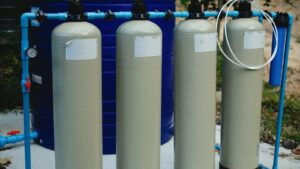
Granular activated carbon (GAC) is packed into pressure filters or columns. The wastewater flows through continuously. GAC suits plants with a steady flow and a constant contaminant load, and the spent carbon can be reactivated.
Powdered activated carbon (PAC) is dosed directly into the water, often into the biological tank or a contact tank before clarification. It suits plants with changing loads, occasional colour problems, or no space for new filters. It leaves the system with the sludge.
Many ETPs use PAC to handle peaks and GAC for continuous polishing. For a full comparison, read our guide to GAC vs PAC.
Choosing the right activated carbon
Wastewater contaminants are often larger molecules than those in drinking water, so pore size matters more than headline surface area.
- Coal-based carbon has a wide mix of pore sizes (more mesopores). It handles large molecules such as dyes, polymers and humic substances well, and is often the best value for wastewater.
- Coconut shell carbon has mainly very small pores. It is best for small molecules such as solvents and phenols, and for the final polish before reuse.
- Wood-based carbon has larger pores and is often used as PAC for strong colour removal.
- Impregnated carbon is treated to capture specific contaminants such as mercury or sulphur compounds.
Compare grades on iodine number, methylene blue or molasses number (a guide to capacity for larger molecules), hardness and ash. The best test is always a sample of your own effluent.
A real example: removing PEI from process wastewater
In one project, First Molecule helped a client remove polyethylenimine (PEI), a large polymer that resists biological treatment, from industrial wastewater. A mesoporous coal-based carbon removed more than 90% of the PEI and helped the client meet its nitrogen discharge limit. Read the full PEI case study.
Tips for better results
- Remove solids and oil first. They coat the carbon and waste its capacity.
- Check pH. Adsorption of many organics changes with pH, so test across your normal range.
- Allow enough contact time. In GAC filters this means sizing the bed for your flow. With PAC it means enough mixing time before the carbon settles.
- Monitor the outlet. Track COD or colour after the carbon so you know when to replace or reactivate it before you exceed limits.
- Run a jar test or column test. A small trial with your own wastewater is the quickest way to choose the grade and estimate carbon use.
How First Molecule can help
First Molecule supplies activated carbon for industrial and municipal wastewater:
Send us your effluent analysis (COD, colour, pH, flow rate and the contaminants you need to remove), and our team will recommend a grade and a test plan. Contact us for a quote.
Frequently asked questions
Can activated carbon reduce COD in wastewater?
Yes. It removes the dissolved organics that remain after biological treatment, which lowers COD. How much depends on the type of organics, so a test with your own effluent is the best guide.
Is activated carbon good for textile dye wastewater?
Yes. Activated carbon, especially coal-based or wood-based grades with larger pores, is widely used to remove colour and dyes from textile effluent.
Should activated carbon go before or after biological treatment?
Usually after. Biological treatment removes most of the easily degradable organics cheaply, and carbon then removes what is left. PAC can also be dosed into the biological tank itself.
Can spent activated carbon be reused?
Spent GAC can often be thermally reactivated and reused. PAC is normally used once and leaves with the sludge.
Read more: activated carbon for water treatment and Transforming wastewater: the power of First Molecule carbon.