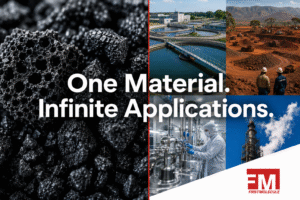
What if one material held the key to cleaner water for a Nairobi municipality, purer gold from a mine in Ghana, safer pharmaceuticals from a plant in Germany, and fresher air in a refinery in Saudi Arabia all at once? That material exists. It has been quietly working across industries for over a century. And yet, despite its extraordinary versatility, activated carbon remains one of the most overlooked strategic assets in global industrial operations
As industries face mounting pressure stricter environmental regulations, increasingly complex purification requirements, volatile raw material markets, and growing demand from emerging economies the conversation around activated carbon supply chains has never been more urgent. For procurement leaders, plant engineers, sustainability officers, and business decision-makers across Africa, Asia, the Middle East, and beyond, understanding what separates commodity carbon from high-performance activated carbon solutions could mean the difference between operational excellence and costly failure
Activated carbon’s power lies in its extraordinary surface area. A single gram can contain up to 3,000 square metres of surface more than half a football pitch packed into a structure that adsorbs contaminants with remarkable efficiency. This makes it indispensable across an astonishing range of critical applications:
Water treatment – removing chlorine, heavy metals, pesticides, and organic compounds from municipal and industrial water supplies
Air purification – capturing volatile organic compounds (VOCs), mercury vapour, hydrogen sulphide, and industrial emissions
Gold recovery – enabling carbon-in-pulp (CIP) and carbon-in-leach (CIL) processes foundational to modern gold mining
Pharmaceutical processing – decolourising and purifying active pharmaceutical ingredients (APIs) and intermediates
Food and beverage production – clarifying edible oils, spirits, sugars, and beverages to exacting quality standards
Solvent recovery – capturing and recycling industrial solvents to reduce waste and operational cost
Oil and gas refining – removing sulphur compounds, mercaptans, and other impurities from process streams
Yet despite this breadth, many industries still treat activated carbon as a generic consumable sourced on price alone, with little attention to quality, consistency, or application fit. That approach is becoming increasingly difficult to defend.
Here is the critical insight that separates sophisticated industrial buyers from the rest: activated carbon is not a commodity. It is a precision-engineered material whose performance depends on a complex interplay of factors raw material source (coconut shell, coal, wood, or peat), activation method (steam or chemical), pore size distribution, surface chemistry, hardness, ash content, and iodine number, among others.
A granular activated carbon (GAC) optimised for gold recovery in a CIL circuit has an entirely different specification from a pharmaceutical-grade powdered activated carbon (PAC) used in API decolourisation. An impregnated carbon designed for mercury removal requires entirely different engineering from one used in air filtration systems
The practical consequences of misspecification are severe:
-In water treatment, sub-standard carbon leads to breakthrough contamination and increased replacement frequency, driving up operational costs
-In gold mining, carbon with poor hardness and attrition resistance causes gold losses and elevated fines generation, directly impacting recovery rates
-In pharmaceutical applications, inconsistent purity profiles risk failing GMP standards and triggering batch rejections
-In food processing, excessive ash content or off-specification surface chemistry can taint product flavour and colour
The lesson is unambiguous: the technical specification of activated carbon must be matched precisely to the application and this requires a supplier with both the product range and the application expertise to make that match correctly.
The global activated carbon market is on a robust growth trajectory, driven by tightening environmental legislation, accelerating industrialisation across Africa and Southeast Asia, the expansion of gold mining operations, and growing public health awareness around water and air quality.
Emerging markets across Africa from Nigeria and South Africa to Kenya and Ghana are investing heavily in water treatment infrastructure. Gold mining operations across West and East Africa are demanding higher-performance recovery carbons. Industrial zones across Indonesia, the Philippines, and Central Asia are scaling up and require reliable, consistent activated carbon supply for air and water compliance.
For procurement teams operating in these markets, three challenges have emerged as defining:
1. Reliability of supply across fragile, import-dependent regional chains
2. Availability of specialised grades as processes grow more sophisticated
3. Technical partnership that reduces total cost of ownership, not just unit price
The activated carbon supply landscape is evolving. The era of sourcing everything from a single distant origin is giving way to a more distributed, regionally intelligent model one where manufacturers maintain production capacity close to end markets, combine global sourcing capability with local application knowledge, and offer the technical depth to support customers through product selection, trial, and optimisation.
This is precisely where First Molecule a global activated carbon manufacturer and supplier headquartered in the UAE, with manufacturing plants across India, Indonesia, China, and the Philippines is positioned to add significant value.
By operating manufacturing and supply infrastructure across Asia, the Middle East, Africa, Europe, and the Americas, First Molecule brings together global production scale with the market presence and responsiveness that regional customers require. Their product portfolio spans granular activated carbon (GAC), powdered activated carbon (PAC), pelletised/extruded carbons (EAC), gold recovery carbon, and specialised impregnated grades addressing the full spectrum of industrial activation requirements.
Each product line is engineered for a specific application environment: FM MAXGOLD targets gold recovery operations; FM AQUA serves water treatment; FM AURA is optimised for air purification; FM THIOVA handles mercury capture; FM OLEO addresses edible and transformer oil purification. This is not a catalogue it is a technical framework built around real industrial problems.
Environmental performance is reshaping procurement decisions across every sector that uses activated carbon. In water treatment, regulators are scrutinising not just the performance of treatment systems but the environmental credentials of the materials used within them. In mining, ESG frameworks are demanding greater accountability for chemical and physical inputs. In pharmaceutical manufacturing, sustainability metrics are increasingly embedded in supplier qualification processes.
For activated carbon specifically, this translates into concrete questions that procurement professionals should be asking of every supplier:
1.What is the raw material source, and is it sustainably managed?
2. Is the carbon regenerable, and what is the regeneration energy footprint?
3. What is the carbon’s performance per unit of product volume how efficiently does it work, reducing total consumption?
4. Does the supplier maintain consistent, tested quality specifications that minimise batch variability and waste?
Selecting an activated carbon supplier is increasingly a strategic decision, not a procurement transaction. Here is a practical framework for evaluation:
Partner Evaluation Framework
✓ Technical depth
Can the supplier provide application-specific recommendations supported by technical data? Do they offer lab support, sample evaluation, and application engineering?
✓ Product breadth
Do they manufacture the full range PAC, GAC, EAC, impregnated, acid-washed, high-activity rather than a one-size-fits-all solution?
✓ Supply reliability
Do they have multi-site manufacturing capacity and regional disribution that protects your operation against single-source disruption?
✓ Quality consistency
Are products manufactured to verified specifications, with batch-by-batch testing and documented quality controls?
✓ Global reach, local presence
Can they serve your region not just logistically, but with the market knowledge and responsiveness your operations require?
✓ Innovation capability
Are they investing in next-generation solutions such as MOF-based carbons and advanced impregnated grades for emerging contaminants?
These criteria define the difference between a vendor and a genuine industrial partner.
Ready to Rethink Your Activated Carbon Strategy?
Explore First Molecule’s full product range or connect with our regional technical teams across Asia-Pacific, the Middle East and Africa, and Europe